Cutting through the bullshit.

Sunday, 22 February 2009

What a dilemma!

Not many people remember his name, but everyone knows Muntadhar al-Zaidi’s shoe size. In one glorious moment on 14 December, the 29 year old al-Baghdadia TV journalist recruited the whole world’s media to display what no analysis or opinion poll, no insurgency or election had, that Iraqis don’t like living under the bootheel of US occupation. Since then, his action has become iconic, with shoe tossing now a staple of protest tactics.


So inspiring was his protest that within a week of the incident, the Baydan Shoe Company in Istanbul, allegedly the manufacturer of al-Zaidi’s shoes, had to hire 100 new workers to cope with 300,000 orders for their Model 271 Ducati, making it perhaps the only employer in Turkey not laying off staff.

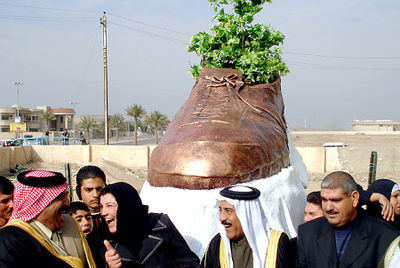
Arrested on the spot and consigned to al-Maliki’s gulag, he was beaten into signing an apology to al-Maliki. While he languished in prison, orphans in Tikrit helped sculptor Laith al-Amiri construct a monument in his honour, unveiled on 29 January and removed the next day,

"We will not allow anyone to use the government facilities and buildings for political motives," said Abdullah Jabara, Salaheddin deputy governor.

Three months down the track, he is finally to stand trial, ‘charged with assaulting a foreign leader and faces a maximum sentence of 15 years’. Unfortunately, Bush was agile enough to evade al-Zaidi’s missiles, although I daresay he’d be facing even more serious charges if they had hit home. Initial hearings in December were held at the prison, where he has been held ever since. presumably to allow time for him to recover from his injuries before appearing in a public courtroom.

In his first public appearance since his arrest, Mr Zaidi was met in court by applause, ululating and chanting…He appeared fit and well, despite reports from friends and family that he was badly beaten shortly after his arrest.

The facts of the case are not in dispute, nor has al-Zaidi denied the charges against him. And in all fairness, it’s inconceivable that a capitalist state would neglect to criminalise assaulting a foreign head of state. But at the same time, the new democracy Mr Bush has so magnanimously bestowed upon the grateful Iraqi people must show its respect for freedom of expression. What a dilemma!

We can only hope that Iraq’s thoroughly independent judiciary will acknowledge what every Iraqi knows and release al-Zaidi immediately, honour him as a hero, with an abject apology and compensation, and let him return to recording the depredations of US occupation.

Saturday, 21 February 2009

A respectable majority

After what I suppose must be ‘a decent interval’, Israeli President Shimon Peres has finally invited Binyamin Netanyahu to try and form a government. Although Bibi’s Likud, with 28 seats, has received the explicit endorsement of Yisrael Beiteinu (15 seats) and the rest of the extreme ultra right – Shas (11), United Torah Judaism (5), Habayit Hayehudi (‘The Jewish Home’; 3), and National Union (4), sufficient to form a government with a small majority in the 120 member Knesset, he has reached out in the spirit of reconciliation to ‘the centrist Kadima Party, led by Tzipi Livni, and the center-left Labor Party, led by Ehud Barak, to join him in a unity government’, as Isabel Kershner wrote in yesterday’s NY Times, ‘He said national unity was necessary in order for Israel to contend with the formidable challenges ahead’. Kadima leader Tzipi Livni is to meet with Netanyahu tomorrow, but many in the media doubt she will buy into his ‘national unity’ proposal.

The principal division between the ‘right’ and the ‘left’ is supposed to be over the establishment of a Palestinian state in the West Bank and Gaza. As Jamie points out on his Heathlander blog, Likud, Kadima, and Yisra’el Beiteinu are of one mind on the issue of loyalty oaths: [Vice Premier Haim] Ramon told Ynet that 90% of Yisrael Beiteinu’s positions correlate with Kadima’s policy. “Even on the subject of loyalty and everything concerning national service – we agree,” he said.’ In a memo to Yisra’el Beiteinu leader Avigdor Lieberman, Likud wrote, ‘We believe that all Israeli citizens, let alone the country’s selectmen, must profess their loyalty to the State of Israel’.

The point is that a Likud led coalition of ‘the right’ ‘would also set Israel on a possible collision course with the new administration in the United States, which has pledged an active and aggressive pursuit of peace’. I’m not convinced that President Obama really wants to see peace, much less justice, in Palestine. But I’m sure he’s committed to ‘the peace process’ and might even insist on the establishment of some kind of rump Palestinian state over the life of his regime. Interestingly, a coalition formed on the understanding that this will not happen could prove to be the acid test of the Walt and Mearsheimer dog wagging hypothesis. Or it might not. After all, it would be imprudent in the extreme to take a slimy character like Bibi’s word at face value. Indeed, my understanding is that Lieberman himself supports, at least as an interim measure, establishment of a Palestinian state, which would annex parts of ‘Israel proper’ with concentrations of Palestinian population in the envisaged land swap. That could mean that Netanyahu would have to relinquish his position whether he forms a coalition with Yisra’el Beiteinu or with Kadima – and even with the support of the four ultra parties, a Likud led government would have to include one or the other, except in the improbable scenario of a highly unstable Likud-Labour coalition with an even slimmer majority, which would also require some compromise on this issue in any case. On the other hand, I suspect Lieberman could content himself with annexing all of ‘Eretz Yisra’el’, provided only those swearing fealty to the ‘Jewish and democratic state’ would be entitled to the franchise.

Advocates of partition often make the point that, as Hussein Agha and Robert Malley wrote (on 17 December, before the Gaza slaughter) in the 15 January issue of the New York Review of Books, ‘Throughout the years, polls consistently showed respectable Israeli and Palestinian majorities in favor of a negotiated two-state settlement’.

In all probability, what they have in mind is responses to questions like

Q16. If the Palestinians committed to stop using violence against Israel and in fact stopped all violence for an extended period, would you favor or oppose Israel allowing the establishment of a Palestinian state outside the 1967 borders, except for some agreed-upon land swaps?

The November 2002 poll that asked that question found that 51% of the 508 Israeli Jews polled favoured allowing such a state. Not what ordinarily passes for a ‘respectable’ majority, even if such a view were respectable at all.

Needless to say, the question starts from the assumptions that the obstacle to Israel allowing a Palestinian state is Palestinian resistance and that it is up to Israel whether to allow it or not. The pollsters are asking respondents to accept these assumptions before they even consider their answer. It would not be terribly surprising if they were willing to do so. The question is more explicit than some in specifying ‘outside the 1967 borders’, even if that form of words is inherently ambiguous. It could mean all of the West Bank and Gaza, or it could just mean Nablus. But doubtless the intent was for the border to follow the Green Line more or less, squiggling to incorporate the big settlements, and I daresay that’s how respondents interpreted it.

Land swaps are part of every proposal for partition of Palestine, in recognition of the ‘facts on the ground’ that Israel has created over the last four decades with the intent of establishing a ‘matrix of control’ over the Palestinians living in the West Bank and ultimately annexing the whole area. As I’ve argued somewhere before, to countenance land swaps is to provide retrospective legitimation for the whole settlement project, sending the unambiguous message that under ‘international law’ if you hold out long enough, you can get away with anything. The point is that to answer the question in the affirmative, you need to accept that the Palestinians in the West Bank and Gaza are entitled to an absolute maximum of 22% of Mandate Palestine, regardless of their needs. Furthermore, as it is silent on the status of Jerusalem and the refugees, those favouring a Palestinian state may want to keep all of greater Jerusalem, or relinquish it, or share it. They may want the refugees to ‘return’ to the new Palestinian state, or receive compensation from The International Community, or really get to exercise their right to return ‘to their homes’. In all likelihood, most of the Israeli Jewish ‘left’ who said they favoured partition would not accept the right of return as expressed in UN General Assembly resolution 194, and few would relinquish any part of Jerusalem.

So while it may be fair to say that 51% of respondents favour a ‘negotiated two-state settlement’, few if any support one that would be acceptable even to abu Mazen. I hasten to add that when they write of a ‘negotiated two-state settlement’, there is an assumption that someone is empowered to negotiate on behalf of the Palestinians, presumably the PA, specifically, the unelected ‘moderate’ PA installed by Abbas and not the elected Hamas terrorists. In other words, the refugees would be represented by a ‘government’ that they had no role in choosing and has squat credibility even among those who did. As for the Israeli Arabs, who also have a stake in any outcome, the Israeli government would obviously represent their needs scrupulously.

In any case, if there was ever a ‘respectable majority’ of Israeli Jews who really supported a Palestinian state west of the Jordan, it seems to have vanished. A poll conducted by Maagar Mochot / Channel 2 on 2-3 February asked 1,894 Israeli adults

In light of the experience with disengagement, the Second Lebanon War and the war against Hamas in Gaza, do you support or oppose the establishment of an independent Palestinian state in Judea and Samaria?

Note that the question envisages a state that excludes Gaza. Nevertheless, only 32% said they supported such a state, with 51% opposed.

As for the Palestinians, only 42.5% of the 1,360 Palestinians in the West Bank and Gaza Strip polled 18-20 September 2008 by An-Najah National University said they supported partition when asked

Do you support or reject the creation of two states on the historic land of Palestine (a Palestinian state and Israel)?

The proportion saying they rejected partition was 54.3%. Curiously, support for partition appears to be on the increase, with 39.5% supporting it and 57.6 rejecting it last May, presumably, but not explicitly, in answer to the same question.

A more recent poll conducted by the Palestinian Center for Policy and Survey Research (PSR) in the West Bank and the Gaza Strip between 3 and 5 December 2008 asked 1270 adults three related questions.

When asked,

29) There is a proposal that after the establishment of an independent Palestinian state and the settlemnet of all issues in dispute, including the refugees and Jerusalem issues, there will be a mutual recognition of Israel as the state of the Jewish people and Palestine as the state of the Palestinians people. Do you agree or disagree to this proposal?

52.5% agreed (7.4% ‘definitely’) and 45.8% disagreed (12.6% ‘definitely’). But in answer to a questions specifically about the Saudi plan,

38) According to the Saudi plan, Israel will retreat from all territories occupied in 1967 including Gaza the West Bank, Jerusalem and the Golan Heights, and a Palestinian state will be established. The refugees problem will be resoved through negotiation in a just and agreed upon manner and in accordance with UN resolution 194 which allows return of refugees to Israel and compensation. In return, all Arab states will recognize Israel and its right to secure borders, will sign peace treaties with her and establish normal diplomatic relations. Do you agree or disagree to this plan?

65.9% agreed (9.2% ‘certainly’) and 30.4% disagreed (7.8% ‘certainly’).

Another question outlined six elements of ‘a permanent compromise settlement’, apparently modelled on the Geneva Accord, and then asked whether respondents agreed or disagreed with each element individually, and with all six as a package.

41) When Palestinians and Israelis return to final status negotiations the following items might be presented to negotiators as the elements of a permanent compromise settlement. Tell us what you think of each item then tell us what you think of all combined as one permanent status settlement

1. An Israeli withdrawal from all of the Gaza Strip and the evacuation of its settlements. But in the West Bank, Israel withdraws and evacuates settlements from most of it, with the exception of few settlement areas in less than 3% of the West Bank that would be exchanged with an equal amount of territory from Israel in accordance with the attached map {show map}.

2. An independent Palestinian state would be established in the areas from which Israel withdraws in the West Bank and the Gaza Strip; the Palestinian state will have no army, but it will have a strong security force but an international multinational force would be deployed to insure the safety and security of the state. Both sides will be committed to end all forms of violence directed against each other.

3. East Jerusalem would become the capital of the Palestinian state with Arab neighborhoods coming under Palestinian sovereignty and Jewish neighborhoods coming under Israel sovereignty. The Old City (including al Haram al Sharif) would come under Palestinian sovereignty with the exception of the Jewish Quarter and the Wailing Wall that will come under Israeli sovereignty.

4. With regard to the refugee question, both sides agree that the solution will be based on UN resolutions 194 and 242 and on the Arab peace initiative. The refugees will be given five choices for permanent residency. These are: the Palestinian state and the Israeli areas transferred to the Palestinian state in the territorial exchange mentioned above; no restrictions would be imposed on refugee return to these two areas. Residency in the other three areas (in host countries, third countries, and Israel) would be subject to the decision of the states in those areas. The number of refugees returning to Israel will be based on the average number of refugees admitted to third countries like Australia, Canada, Europe, and others. All refugees will be entitled to compensation for their "refugeehood" and loss of properties.

5. When the permanent status agreement is fully implemented, it will mean the end of the conflict and no further claims will be made by either side. The parties will recognize Palestine and Israel as the homelands of their respective peoples

6. The Palestinian state will have sovereignty over its land, water, and airspace. But Israeli will be allowed to use the Palestinian airspace for training purposes, and will maintain two early warning stations in the West Bank for 15 years. The multinational force will remain in the Palestinian state for an indefinite period of time and its responsibility will be to insure the implementation of the agreement, and to monitor territorial borders and coast of the Palestinian state including its international border crossings.

Only 41% agreed with the full package, and 57.4% disagreed, 14.7% ‘strongly’. To be honest, I find it mysterious that 52.5% agreed with Q29, 65.9% with Q38, but only 41% with Q41. Just speculating, though, Q29 explicitly demands ‘recognition of Israel as the state of the Jewish people and Palestine as the state of the Palestinians people’, wording I would consider objectionable. I don’t know how familiar respondents would have been with the wording of The Arab Peace Initiative, but it is short on detail and may enjoy some undeserved credibility because it is the consensus of ‘the Arab world’. As for Q41, when presented with a detailed proposal for six central issues, it doesn’t look very enticing. Specifically, 58% rejected the plan for the refugees in point 4; 63.3% objected to the partition of Jerusalem in point 3; 68.5% didn’t like the ‘security’ arrangements in point 6, and 72.5% disagreed with the multinational force, etc. in point 2.

Ultimately, though, the Palestinians surveyed were not optimistic about the prospects for a Palestinian state. When asked

32) Now 40 years after the Israeli occupation of the West Bank and the Gaza Strip, what in your view are the chances for the establishment of an independent Palestinian state next to the state of Israel in the next five years? Are they high, medium, low, or none [sic] existent?

34.6% said they were nonexistent, 34.9% low, 23.9% ‘medium’, and just 4.8% high. If ‘an independent Palestinian state’ means something along the lines of Barak’s 2000 ‘generous offer’, or worse, I’d say there’s a pretty good chance we’ll see such bantustans by 2013, particularly if Livni agrees to join Bibi’s coalition. But meaningful independence? Fuggeddaboudit.

Thursday, 12 February 2009

Principles at stake

UNRWA must have read my post last Sunday, because, according to Ron Kampeas, they resumed distributing aid in Gaza on Monday. Now, UNRWA’s former chief legal counsel, James Lindsay, has prepared a critique for WINEP (Washington Institute for Near East Policy) – a den of hasbarists founded by Martin Indyk and boasting on its advisor board, Edward Luttwak, Richard Perle, George P. Shultz, and R. James Woolsey, among others – calling UNRWA ‘part of the problem’. Apparently UNRWA ‘allows itself to be politicized by the Palestinians’. According to Kampeas, ‘He noted instances in which UNRWA did not immediately condemn Hamas rocket fire into Israel.’

Meanwhile,

In the U.S. Congress, Reps. Steve Rothman (D-N.J.) and Mark Kirk (R-Ill.) are reviving their campaign to cut U.S. funds to UNRWA until it comes clean about what the lawmakers say are its irregularities and its coziness with terrorists. The United States provides between a fifth and a quarter of UNRWA's $440 million to $540 million annual budget.

It seems that there are allegations that UNRWA may have employed members of Hamas, even though they have adopted a ‘practice of periodically running staff names through Israel's intelligence services and summarily removing staffers with suspected terrorist ties’.

Rothman and Kirk have also approached the Conference of Presidents of Major American Jewish Organizations to write to Secretary of State Hillary Rodham Clinton suggesting she cut funding ‘until a U.S. review of the agency is completed’ instead providing aid through ‘bilateral assistance mechanisms’.

The beauty of bilateral aid is that it’s a good way to dump your agricultural surplus. Aid agencies also approve projects that require the recipient to retain the services of a service provider in the donor country, typically at a net cost to the ‘beneficiary’. Approval of projects requires – I kid you not – pre-feasibility studies, feasibility assessments, semiannual evaluations, post project monitoring, etc., providing a goldmine for donor country ‘consultants’.

Kirk is scandalized because

"It's against U.S. law to have U.S. taxpayer dollars flow to a terrorist organization," he said. "During the worst economic crisis since the Great Depression, it is unacceptable that an organization receiving U.S. financial aid should not be required to be accountable for every dollar it receives."

"There are basic principles at stake here," Kirk said. "The spending of U.S. taxpayer funds should be transparent and accountable, and bad activities should have consequences."

It goes without saying that basic principles don’t apply in the case of the no strings attached US$3 billion per annum in military aid to Israel, the Arms Export Control Act notwithstanding. Considering his profound concern for accountability, you may be astonished to learn that Mark Kirk was not among the five Illinois Republicans who voted against Bush’s $700 billion bank bailout.

A shift to the right?

With only a few thousands absentee ballots left to tally, it appears that Israel’s next prime minister is likely to be the Likud’s thuggish Binyamin Netanyahu, as expected. Recall that the reason this election was called in the first place was that Kadima leader Tzipi Livni was unable to cobble together a coalition following Ehud Olmert’s resignation in disgrace a few months ago.

At that time, when Kadima, Labour, Meretz, and Gil, the pensioners’ party held 60 seats between them, she still needed the religious Shas party to garner a majority in the Knesset, and Shas declined to join her coalition. Now, with the three parties of the so called ‘left’ scoring a total of 44 seats – Gil has not won any seats in the new Knesset – it will be impossible to form a majority government without including either Likud, Avigdor Lieberman’s Yisrael Beiteinu, or Shas, even if she were to invite Hadash, or one of the Arab parties – Ta’al or Balad – which of course is unthinkable.

So I reckon the most probable outcome is that President Peres will ask Netanyahu to form the next government, although it is possible that as the leader of the party with the largest bloc in the Knesset, she will have the first go and either bite the bullet and form a coalition with a party of the ‘right’ or fail to form a coalition within the required six weeks again, in which case, I believe, the role will fall to Netanyahu, anyway.

One way or the other, a party of the ultra right will be in a position to veto any initiative by threatening to leave the coalition and bring down the government. Not that I think it’s going to make a great deal of difference. It was, after all, only late in 2005 that the unlamented Ariel Sharon split from Likud, the party he led at the time, to form Kadima, because his Likud colleagues refused to endorse his plan for unilateral ‘disengagement’ from Gaza. Kadima, like Likud, is inspired by ‘Revisionist’ Zionism. Livni is an admirer of Vladimir ‘Ze’ev’ Jabotinsky. When push comes to shove, there’s not much distance between Labour and Revisionist Zionism. They may appear to be more or less tolerant of Palestinians in the Jewish homeland, but in their heart of hearts, and often enough in their speech, they want them gone one way or another. Their difference, such as it is, is tactical.

There is one other difference. Publicly, Labour Zionists have always tried to pretend that they were settling terra nullius. I think that’s where all this ‘A land without people for a people without land’ and From time immemorial stuff comes from. Jabotinsky, at any rate, was perfectly explicit about needing to uproot the natives.

Netanyahu, left to his own devices, will not consider relinquishing any part of the West Bank or any Palestinian ‘state’ west of the Jordan. Livni, if not hamstrung by coalition partners – an unlikely scenario, would complete the wall, annex the main settlements, aquifers, and corridors, and leave the Palestinians on the West Bank in three or four little enclaves divided from each other, as well as from Gaza, and Jordan, by Israeli territory. Israel will control all borders and airspace. Basically, Barak’s famous ‘generous offer’. In short, they would find themselves in much the same situation as Gaza has been since the ‘disengagement’. True, for a couple of years there were no Israeli soldiers on the streets of Gaza, but I’m not sure encirclement and siege by a ‘hostile entity’ is much of an improvement, if any.

Furthermore, on 3 February, Livni told Globes,

I agree to concede part of the Land of Israel, but the moment I undertake this, it must be clear that Israel is the national home of the Jewish people, and a future Palestine is the full national solution for the Palestinians, wherever they are.

In other words, once she permits the Palestinians to print their own postage stamps, whether through negotiations with the quisling PA, or through unilateral ‘disengagement’, those postage stamp size ghettos will be ‘the national home’ of the Palestinians, thereby washing her hands not only of those living in the West Bank and Gaza, but the four or five million refugees. It’s not absolutely explicit, but she expressed similar sentiments a few months ago, and as I read it, that would mean the Palestinians with Israeli citizenship, too. In this, her position is indistinguishable from Lieberman’s, who campaigned on a platform of requiring Israeli Arabs to take an oath of allegiance to the Jewish state or relinquish their citizenship. As far as I know, every country requires such oaths of immigrants seeking citizenship, and none demands it of the native born, as it would render them stateless. If any other country did so, it would meet with howls of indignation, not least from those who applaud Lieberman’s initiative.

Ultimately, I don’t think it means very much to say this election evidences a shift to the right. I’ve often criticised opinion polls that ask respondents, mainly in the US, to place themselves somewhere on a continuum between ‘Liberal’ and ‘Conservative’ on the grounds that that only comprises a sliver of the political spectrum. The distance from left to right in Zionist politics is narrower still. Even Meretz was delighted to see Gaza bombed to smithereens. From my perspective, it makes no sense to call a party favouring ethnocracy, as all Zionist parties must, by definition, ‘left’. Left and right are of course relative terms, but I don’t think you can distinguish them by subtle differences over the timing or mechanism of ‘transfer’.

Sunday, 8 February 2009

Join the fun

‘With international aid organizations describing the Gaza situation as a humanitarian crisis following the recent war,’ writes Jenna Hanson in the Jewish Telegraphic Agency, Associated Press writer Josef Federman reports that

The U.N. agency for Palestinian refugees suspended aid to the Gaza Strip on Friday, accusing the territory's Hamas rulers of stealing a delivery of humanitarian supplies for the second time this week…"Hamas has got to hand back all the aid that they have taken and they have to give credible assurances that this will not happen again. Until this happens, our imports into Gaza will be suspended," said UNRWA spokesman Chris Gunness.

So, with hundreds of thousands of grieving, homeless, destitute people facing starvation, UNRWA, the agency responsible for their welfare, has determined that they can just go ahead and starve due to a demarcation dispute over who gets to distribute the flour and rice. Much as I deplore The International Community picking up the tab for Israel’s rampage, I want to see ample relief flow to the suffering Gazans as a matter of urgency. The UN’s latest exercise in cynicism, coupled with The International Community’s refusal to end Israel’s siege, and agreement that a ‘durable ceasefire’ must preclude Hamas from ‘rearming’ at all costs, illustrates just what value they place on the lives of Palestinians.

Israel is grappling with how to allow in necessary aid while keeping material that could be used against Israel out of the hands of Hamas,’ Hanson explains.

Peter Lerner, a spokesman for the office of Coordination of Government Activities in the Territories, distinguishes ‘immediate needs, such as medical supplies, food, fixing the windows -- all the things that are needed right now’ from ‘more long-term needs, such as rebuilding buildings and fixing hospitals and schools’.

According to Ran Yaron, director of the Occupied Territories Department at Physicians for Human Rights in Israel, ‘The windows of many homes and hospitals were broken during the war, and Israel is currently not allowing glass into Gaza.’

Gisha: The Legal Center for Freedom of Movement, spokesman Itamar Shachar said Israel is obstructing spare parts for water, sewage and power systems to enter the strip and has only permitted the passage of 64 percent of the fuel necessary to run Gaza's power system.

‘We will not allow hoses to pass in freely because hoses are put into rockets. We will not allow an unchecked amount of cement and concrete to enter because they will be used to build bunkers and underground tunnels for use against our soldiers,’ Lerner added. ‘My first job is to protect the citizens of Israel.’

To her credit, Hanson resists the obligation to write, as Federman does, ‘Israel unilaterally halted its devastating Gaza operation, meant to halt years of Hamas rocket attacks, on Jan. 18’. Nor is it just the dispassionate media who insist on painting Israel’s slaughter as self defence. In an advertisement in the Sydney Morning Herald entitled ‘The slaughter in Gaza’, 34 Australian luminaries, ‘condemn Israel’s disproportionate and indiscriminate use of force in response to Hamas’ rocket attacks’!

Meanwhile, the 700 courageous girls and boys who are patrolling the border to keep Israelis safe from window- and hose-wielding Palestinians are hungry, too.

Just in case you’ve been wondering why Israel expects its adversaries to stash their weapons in mosques, Noa Kocharek and Yuval Goren reported in Ha’aretz

Two Israeli curators on Thursday stumled [sic] upon an arms cache dating back to the British Mandate at a Synagogue in Hod Hasharon.

The weapons, which included grenades and bullet casings, were apparently stored in the building by the Hagannah Jewish militia.

Klein said that during the British Mandate, the synagogue used to serve as a shelter from Arab rioters, and therefore has long and narrow windows, and slits for firing. These slits apparently made the synagogue an ideal location for stashing the weapons.

But then, of course, the Hagannah were freedom fighters, not terrorists, like Hamas.

Friday, 30 January 2009

Land rights when?

The ABC reported today

The [Northern] Territory Government and [Larrakia Aboriginal] traditional owners have reached an in-principle agreement over 65,000 hectares of land on the Cox Peninsula, ending the longest-running land claim in Australia's history.

The claim was first lodged in 1979.

Actually, according to a chronology by David Parsons published in the Indigenous law bulletin in 1998, what happened on 20 March 1979 was a

consolidated claim for entire area lodged by the Northern Land Council. The claim includes various islands and reefs to the west of the Cox Peninsula, Bynoe Harbour, Port Patterson, and the Cox Peninsula itself. This consolidated claim is what became known as the 'Kenbi Land Claim'. The original claimants, 7 named members of the Danggalaba clan, are replaced by 3 groups of Larrakia and Wagaitj people.

The first formal Larrakia land rights claim for the Cox Peninsula and adjoining islands dates to 23 September 1976.

On 22 December 1978, Parsons writes,

the Administrator of the NT makes regulations under the Town Planning Act (NT), which were notified in the Gazette of 29 December 1978. By these regulations the NT Government declares Cox Peninsula a portion of the town of Darwin (the expansion of the town from 142.4 km2 to 4,350 km2 makes it about 3 times the size of Greater London). The townships of Katherine, Tennant Creek and Alice Springs are similarly expanded. Section 3 of the Aboriginal Land Rights (NT) Act excludes 'land within a town' from claims under the Act.

The expansion of all the significant population centres in the NT well beyond any possible need provides an inkling of how desperately the NT government and the business interests were to prevent Indigenous people from securing rights to any of their land. When I write, ‘significant’ by the way, I use the term rather loosely – Darwin’s population of about 120,000 is four times that of the next largest town, Alice Springs. Katherine’s population is under 10,000, and Tennant Creek’s about 3000.

While Mandora, the nearest point to Darwin on the Cox Peninsula is just a 15 minute ferry ride from Darwin, it’s 138km by road.

Google Earth image

And after all that, the Larrakia will only be getting 52,000 of their 65,000 hectare claim declared Aboriginal land. Not only that, it’s not over yet, as the Commonwealth Government still has to seal the deal, and who knows how long that will take. I don’t believe it would be the first time a land claim has dragged on so long that none of the claimants live to see it settled.

Sympathy for the Devil

Four days after Israel tanks rolled into the Gaza strip, the Pew Research Centre for People and the Press conducted a poll of 1503 Americans, asking, ‘In the dispute between Israel and the Palestinians, which side do you sympathize with more, Israel or the Palestinians?’. Their principal finding was that 49% sympathised more with Israel, and 11% with the Palestinians. Another 5% volunteered that they didn’t sympathise with either side, and 15% with both, while a remarkable 20% didn’t know. Since Pew did not offer ‘Neither’ and ‘Both’ as response options, but only recorded them when respondents insisted, some, possibly all, of those who ‘Don’t know’ may actually have sympathised with both or neither.

As always, there are problems with the question, although in my view they are far from the most egregious I’ve seen in recent opinion polls. It suggests that there is some kind of parity between ‘Israel’ and ‘the Palestinians’, without actually presupposing or even implying it. Indeed, by naming the country in the case of Israel, and the group of people in the case of the Palestinians, there is almost a hint that there may be some difference, at least in status, but I’m dubious that respondents would have been terribly sensitive to the distinction, except insofar as they might think that being an actual country confers some special legitimacy on Israel. What I suspect would have influenced their answers most is a warm visceral reaction to ‘Israel’ and a corresponding aversion to its perceived enemies. I doubt many respondents would have interpreted ‘the Palestinians’ as incorporating those with Israeli citizenship or in the diaspora.

Now people who read blogs like this are well aware that there was nothing defensive about ‘Operation Cast Lead’, but I’m not entirely confident the same can be said about those who rely on the mainstream media for ‘information’. Since virtually every article about Gaza incorporates a compulsory reference to Israel’s wish to end rocket attacks, casting Israel in the role of victim, I find it surprising that there wasn’t even more support for Israel. But even given the propaganda environment, even for those who firmly believe the hasbarists’ claims about the lengths the IOF went to in avoiding civilian casualties, it’s appalling that only 11% found it in their hearts to sympathise with the mangled orphans on their television screens.

The Pew report, which uncharacteristically omitted to mention the ‘margin of error’, compares the results of the 7-11 January poll with polling results for six European countries from April-May 2007, during the period of the Hamas-Fatah unity ‘government’ in the West Bank and Gaza, concluding that there was ‘more support for the Palestinians than the Israelis’. Under such different conditions, the comparison isn’t really valid. But it seems likely that support for Palestinians in Europe would be higher now than it was in 2007, before the abortive June Fatah coup in Gaza. What they found then was that in Britain, France, Italy, Spain, and Sweden, there was a significant margin of support for the Palestinians over the Israelis, while in Germany more supported Israel. Half of those polled in Italy volunteered, ‘Neither’. Overall, among the six countries, 22% supported Israel, 27% the Palestinians, and 32% volunteered ‘Neither’.

I remain very sceptical of self identification as an indicator of political orientation, but there is a clear correlation between orientation, as measured by Pew, and sympathy to Israel over the Palestinians. Sixty percent of ‘Conservative’ respondents, 50% of ‘Moderates’, and 33% of ‘Liberals’ sympathised more with Israel, while 8% of Conservatives, 11% of Moderates, and 21% of Liberals sympathised with the Palestinians. In every group, there was significantly higher support for Israel than for the Palestinians,

Overall, sympathy for Israel over the Palestinians in the US has increased by 9 percentage points since a poll conducted just prior to the destruction of the World Trade Centre in September 2001, but declined from 52% in August 2006, immediately after Israel’s depredation of Lebanon. It would have been interesting to see the movements in sympathy for the Palestinians over time, but Pew doesn’t report them.

Meanwhile, for the first time, a group of US academics have launched a campaign for the academic and cultural boycott of Israel. Eight days into the initiative, it appears that only 52 have endorsed the call for

1) Refraining from participation in any form of academic and cultural cooperation, collaboration or joint projects with Israeli institutions that do not vocally oppose Israeli state policies against Palestine;

2) Advocating a comprehensive boycott of Israeli institutions at the national and international levels, including suspension of all forms of funding and subsidies to these institutions;

3) Promoting divestment and disinvestment from Israel by international academic institutions;

4) Working toward the condemnation of Israeli policies by pressing for resolutions to be adopted by academic, professional and cultural associations and organizations;

5) Supporting Palestinian academic and cultural institutions directly without requiring them to partner with Israeli counterparts as an explicit or implicit condition for such support.

As I’ve written before, I think it weakens the initiative considerably to exempt institutions that ‘vocally oppose Israeli state policies against Palestine’, because it ‘would put them in the invidious position of taking action to undermine their colleagues without being willing to accept the consequences themselves’. Furthermore, while a selective boycott like this may provide an incentive for universities to express vocal opposition, while sectors outside academia remain untouched. Still, you have to start somewhere, and I certainly encourage any American academics who happen to read this to sign on by emailing the campaign at ‘uscom4acbi [at] gmail.com’.

In contrast, when Alan Dershowitz called on ‘Academic and Professional Colleagues From Around The World’ in June 2007 to endorse this statement

"We are academics, scholars, researchers and professionals of differing religious and political perspectives. We all agree that singling out Israelis for an academic boycott is wrong. To show our solidarity with our Israeli academics in this matter, we, the undersigned, hereby declare ourselves to be Israeli academics for purposes of any academic boycott. We will regard ourselves as Israeli academics and decline to participate in any activity from which Israeli academics are excluded. "

4568, including some who were themselves Israeli or affiliated with Israeli institutions, responded within the first 11 days or so. Although the petition was relaunched last May, it, too, has now closed. The total now stands at 12,113, well short of their goal of 20,000 signatories, but still rather intimidating. I hope that the USACBI initiative will soon overtake Dershowitz’s, but I’m not holding my breath.

In another encouraging recent development, a Maritime Union of Australia (MUA) delegates meeting in Western Australia on Tuesday adopted the following resolutions, among others:

1. This delegates’ meeting of the WA branch of the MUA [hereafter this meeting] calls on the Rudd government to denounce the latest Israeli aggression against Gaza, and to cut all economic, diplomatic, cultural and political ties with the Israeli state until this aggression and the Israeli siege of Gaza ends.

4. We will participate fully in the Boycott, Divestment and Sanctions (BDS) campaign when it is initiated and support actions related thereof when they are called by either Friends of Palestine WA or other interested parties (including other trade unions). We call on the ACTU and Unions WA to join us in supporting the BDS campaign and specific actions related thereof

5. In furtherance of resolution 4, this meeting recommends State Conference adopt a position of boycotting all Israeli-registered vessels, and all vessels known to be carrying either goods destined for Israel or goods sourced from Israel. [Hat tip to Amy Thomas]

There’s not a great deal of trade between Israel and Australia, but what there is would almost certainly pass through Western Australian ports. While these resolutions are just a first step to the MUA actually blacking Israeli goods, it’s hard to exaggerate the move’s significance as a gesture. If wharfies in Europe and the US were to follow the WA MUA delegates’ lead, they could cripple the Israeli economy. Which just goes to show, when push comes to shove, it’s the ordinary working people who can really make a difference.

Monday, 26 January 2009

Natural adherence

Although I’ve often criticised Uri Avnery in the past, you can’t help admiring the guy. He’s 85 and still writing a weekly column and still active in the Israeli peace movement, such as it is.

Still, in his piece this week, where he optimistically envisages an ‘abyss’ opening between the Obama regime and whatever government eventuates in next month’s Israeli election, one paragraph just leapt off the page.

Where are the American Jews? The overwhelming majority of them voted for Obama. They will be between the hammer and the anvil – between their government and their natural adherence to Israel. It is reasonable to assume that this will exert pressure from below on the “leaders” of American Jewry, who have incidentally never been elected by anyone, and on organizations like AIPAC. The sturdy stick, on which Israeli leaders are used to lean in times of trouble, may prove to be a broken reed.

The assumption that American Jews, who have never shown much interest in bringing their ‘leaders’ to heel, are now suddenly going to ‘exert pressure’ on officials who are not and never have been accountable to anybody in part precisely because nobody has ever elected them, and that they’re going to do this on the basis that they voted overwhelmingly for Obama, is decidedly not reasonable.

But you get used to that kind of pollyannaism.

What sticks out like dogs’ balls is not the imagined conflict ‘between their government and their natural adherence to Israel’ but the concept of a ‘natural adherence’. It’s not in doubt that a significant majority of American Jews have some kind of adherence to Israel. The American Jewish Committee’s 2008 Survey of American Jewish Opinion reveals that the proportion claiming to feel ‘Very close’ or ‘Fairly close’ to Israel had only declined slightly from 70% in December 2007 to 67% in mid September 2008, while the proportion who feel ‘Fairly distant’ or ‘Very distant’ rose by two percentage points to 23%.

But what’s so natural about that? He can’t be suggesting that American Jews are inherently hardwired to adhere to the Zionist state. After all, the 23% who feel distant from Israel suggests that it couldn’t be natural in that sense. So he must mean that there’s something about Israel’s Jewishness that attracts American Jews’ adherence, because they are Jews. But there’s nothing intrinsically attractive to American Jews, or anybody anywhere, about an explicitly imperialist endeavour to establish a racist ethnocracy on the basis of a campaign of terrorism and ethnic cleansing. Indeed, many American Jews are quite adamantly opposed to racism, ethnocracy, terrorism, and ethnic cleansing. There’s nothing in the least natural about adherence to Israel – it’s drummed into American Jews from their first day at Hebrew School, if not from infancy.

Since I’ve raised the AJC survey, I might as well provide a little more detail. Back in December 2007, I posted an analysis of the 2007 iteration. Unsurprisingly, the release of the report last September went right by me even though it was the first item in the AJC’s 3 October News update. Better late than never.

The 2008 Survey, carried out in mid September, once again by polling firm Synovate, only asked 15 questions, less than half the 38 asked in 2007, and with a focus on the US presidential election – three (20%) specifically asked about candidates. The sample in 2008 was also nearly 9% smaller than the 1000 ‘self-identifying Jewish respondents’ surveyed in 2007, although they claim the same 3 percentage point margin of error.

Bearing the margin of error in mind, as well as my critique of the question in ‘Who pays the piper’, in 2008, the proportion describing themselves as ‘Extremely liberal’, ‘Liberal’, or ‘Slightly liberal’ increased by a probably insignificant one percentage point, from 43% to 44%, while those claiming to be ‘Extremely conservative, ‘Conservative’, or ‘Slightly conservative’ correspondingly declined from 24% to 23%. It’s not clear where the thousands of hasbara-addled fanatics shrieking for blood on the streets of New York, or the dozens of protesters who blockaded the Israeli consulate in San Francisco and Los Angeles, would place themselves on the AJC’s political spectrum.

Thirty-eight percent ‘think there will come a time when Israel and its Arab neighbors will be able to settle their differences and live in peace’, one percentage point more than in 2007, while the proportion who don’t think so also rose by the same amount to 56%. More significantly, 22% now ‘think that Israel can achieve peace with a Hamas-led Palestinian government’, five percentage points more than the previous year, with 68% disagreeing, compared with 74% in 2007. But that was in September, long before Israel’s very existence came under mortal threat again when Hamas inexplicably started launching Qassam rockets in November.

Perhaps the most telling among the fifteen questions asks whether respondents support or oppose ‘...the United States taking military action against Iran to prevent it from developing nuclear weapons?’. Those opposed declined significantly by ten percentage points to 47% while the proportion supporting a war on Iran has risen from 35% in 2007 to 42%. Since only 23% said they were ‘Conservative’, at least 12% of the American Jews who have swallowed the line about Iran developing nuclear weapons and accepted the US’s role as cop of the world must have been ‘Liberals’ or ‘Moderates’.

J Street, the ‘liberal’ Jewish lobby, commissioned an internet survey of ‘800 self-identified adult American Jews’ that was designed by Gerstein | Agne Strategic Communications and conducted by YouGovPolimetrix between 29 June and 3 July last year. If Synovate asks leading questions that beg all kinds of assumptions, Gerstein | Agne have certainly outdone them. Each of the 91 questions are so long and complex that it’s hard to make any sense out of National Survey of American Jews, even if you believe that respondents followed the questions. One question (Q51), however, although not collecting the same concept as the AJC survey’s, may provide a comparative measure.

A plurality of 48% said they would be more likely to vote for a candidate enunciating the following position:

America must do everything it can to protect Israel's security. This means militarily attacking Iran if they pursue a nuclear weapons program, supporting an Israeli pre-emptive strike against Iran, cutting off aid to the Palestinians if their schools allow textbooks that don't recognize Israel, and letting the Palestinians know where we stand on Jerusalem by moving the U.S. embassy from Tel Aviv to Jerusalem.

J Street’s analysis alleges, ‘Instead of holding the hawkish or hard line positions often expressed by many established Jewish organizations and leaders, American Jews overwhelmingly favor assertive peace efforts’. When nearly half of US Jews admit that that kind of bellicose rhetoric would draw them to a congressional candidate, I’d come to quite a different conclusion. As for the 41% who said they’d be less likely to vote for such a candidate, there’s no way of knowing whether they oppose attacking Iran, disagree about the extent of American protection of ‘Israel’s security’, object to dictating the content of foreign textbooks, or any of a range of other combinations of assertions and implications contained in the statement.

I haven’t seen any polling of US Jews since 27 December, but in a Rasmussen telephone survey of ‘1,000 Likely Voters’ – not just Jews – on 9-10 January, more than two weeks into the slaughter, 56% blamed ‘the Palestinians’ for ‘the current situation’, as Rasmussen so delicately put it. A plurality of 45% said Israel should ‘have taken military action against the Palestinians’ in preference to trying ‘to find a diplomatic solution’.

Change we can believe in

I was planning to post excerpts from Mark Steele’s column in Wednesday’s Independent. But when I went to retrieve the URL, guess what

Sorry but we haven't been able to serve the page you requested - please try again

Well, I have tried again, and again. As there’s no problem loading other content on the site, I surmise this column has been removed, probably for reasons that won’t be hard to fathom. So here it is in full for your delectation.

Mark Steel: Now we've all seen through the Israeli government's excuses

If the Hamas rockets are so lethal, why doesn't Israel swap an F-16 for some?

Wednesday, 21 January 2009

The worrying part about whether the ceasefire in Gaza can hold together will be whether the international community can stop the flow of arms to the terrorists. Because Israel's getting their planes and tanks and missiles from somewhere and until this supply is cut off there's every chance it could start up again.

The disregard for life from these terrorists and their supporters is shocking. For example Thomas Friedman, the New York Times columnist, wrote that the purpose of the Israeli attack must be to "inflict a heavy death toll and heavy pain on the Gaza population".

Replace "Gaza" with "western", and that could have been written by al-Qa'ida. Maybe this is the problem: the Israelis are writing their policies by downloading statements from an Islamic Jihad website and just changing the place names. Also, if the Israelis think the Hamas rockets are as lethal as they say, why don't they swap their F-16 fighters and Apache helicopters for a few of them?

These things are capable of terrorising a whole nation for years apparently, yet the Israelis have neglected to buy any, wasting their money on gunboats and stuff. Given that their annual arms budget is $7.2bn plus $2.2 bn in "aid", they'd save enough to buy a selection of banks in every country in the world.

The military advantages would be enormous because the Israelis' complaint about Hamas is the use of tunnels to smuggle arms. But if Israel gave Hamas a few planes and tanks and helicopters, they could probably be persuaded to shut down those tunnels that seem to be the cause of such bad feeling.

Whatever you say about Israel, at least it moves its weapons about legally – except for when it secretly built a nuclear arsenal against an array of international agreements. But they did it above ground and not in a tunnel and that's the main thing. [Note: I’m not sure most of the Dimona nuclear facility is in fact above ground. Part of it is. EH]

Watching the reports from Gaza, another reason why the ceasefire may break down becomes apparent. The Israelis might claim that their satellite pictures now show Palestinians in possession of huge mounds of rubble – lethal if thrown over the border. Luckily these weapons are easy to spot. Most of them are next to women howling, "Look what they've done to my house," but perhaps the airforce should bomb them again – just in case. The Israelis say they fear Hamas will once again break the ceasefire by sending over those rockets. But the whole point of the operation was to make that impossible. Because they must have asked themselves the question, "If we slaughter 1,300 people, including 300 children, is that likely to make people: A. less cross or B. more cross?" And presumably they concluded it will make them much less likely to grow up full of hatred and determination to retaliate. Perhaps they saw medical research that shows when someone is suffering from anxiety and bouts of irascible ill-tempered behaviour, the best treatment is to pen them in with no food or medicine and then kill some of them, and that calms them down a treat.

Another way to allay their worries about Hamas breaking the ceasefire is to read the report from their government's own Intelligence and Terrorism Information Centre. This states that during the ceasefire "Hamas did not take part in any rocket fire and sometimes prevented other organisations from attacking." Still, with all that's been going on I suppose they haven't had time for reading.

Despite all this there might be one cheery sign, which is that never before have so many people seen through the Israeli government's excuses for handing out mass destruction. The demonstrations in support of Palestinians have been bigger than ever before, and even the United Nations and the Wall Street Journal have suggested Israel has committed war crimes. One poll in America suggested that 60 per cent of people opposed the bombardment, and the change of opinion reached the point that an Israeli diplomat has admitted that "The harm to civilians in Gaza is causing us huge damage."

Maybe, best of all, was genetics expert Steven Rose who appeared on Radio 4's Today programme to talk about a new study that's located "morality spots", the part of the brain that deals with our morality. [Gary Olson on the ‘mirror neuron system’ alleged to hardwire human beings for empathy. EH] Asked how we could know whether this was true, he said in a marvellously posh academic Radio 4 voice "Well we could test the brains of the Israeli cabinet and see if they've got no morality spots whatsoever."

And the most immoral part of all is the perfectly cynical timing, as if three weeks ago Bush shouted: "Last orders please. Any last bombing, before time's up? Come along now, haven't you got homes to demolish?"

Back in the States, President Obama has wasted no time clarifying his position on the slaughter in Gaza. Over at Jews sans frontiers, Gabriel has already deconstructed Obama’s remarks.

Let me be clear: America is committed to Israel's security. And we will always support Israel's right to defend itself against legitimate threats…Hamas must meet clear conditions: recognize Israel's right to exist; renounce violence; and abide by past agreements…the United States and our partners will support a credible anti-smuggling and interdiction regime, so that Hamas cannot rearm…

Or, as Joseph Massad put it on Electronic Intifada on Tuesday,

…while Israel has the right to defend itself, its victims have no similar right to defend themselves. In fact, the logic is even more sinister than this and can be elucidated as follows: Israel has the right to oppress the Palestinians and does so to defend itself, but were the Palestinians to defend themselves against Israel's oppression, which they do not have a right to do, Israel will then have the right to defend itself against their illegitimate defense of themselves against its legitimate oppression of them, which it carries out anyway in order to defend itself legitimately.

Obama continued,

Now is the time for Arab states to act on the initiative's promise by supporting the Palestinian government under President Abbas and Prime Minister Fayyad, taking steps towards normalizing relations with Israel, and by standing up to extremism that threatens us all.

That would be the same President Abbas whose term expired a fortnight ago, and the same Salam Fayyad who abu Mazen himself appointed to the position after Israel abducted and incarcerated many of the elected Palestinian Legislative Council members and Abbas dissolved the ‘unity government’ that Hamas had agreed to form in spite of winning the January 2006 election outright.

That election, by the way, is often described as ‘free and fair’. I beg to differ. There is no such thing as a fair election under military occupation – voters are always conscious of and sensitive to the Damoclean sword of looming unspoken but well understood consequences of electing the wrong candidates. Even if it were possible, the restrictions placed on the movement of candidates, the harassment many of them suffered, the influx of US funds for Abbas to distribute to his supporters…ensured that in this case, the election was anything but fair, even if observers detected no widespread fraud on the day. What surprised me, and I think just about everyone, was that with the deck stacked so comprehensively against them, Hamas still managed to secure a decisive majority of seats. Aside from the fact that there is no Palestinian state and therefore no ‘Palestinian government’, by identifying the Presidential overstayer who usurped the elected Council and his illegally appointed PM as the ‘government’, President Obama signals his attitude to democracy, even to the democratic trappings of elections and terms of office.

The United States will fully support an international donor's conference to seek short-term humanitarian assistance and long-term reconstruction for the Palestinian economy. This assistance will be provided to and guided by the Palestinian Authority.

As many have written, one of the expected outcomes of Israel’s slaughter and demolition of Gaza is to transform Gaza from a political to a humanitarian issue, reducing the Palestinians to objects of pity and recipients of charity, at Israel’s pleasure, of course. An ancillary objective may well have been to ensure that Hamas is to have no role in reconstruction. Since much of Hamas’s popularity and street cred arises specifically from its provision of services that the Fatah led PA was too corrupt to manage, that could be a comparatively effective tactic for undermining Hamas. But short of keeping troops within Gaza, it’s hard to imagine how they intend to exclude Hamas.

The BBC’s refusal to broadcast, in accordance with an arrangement in place for over four decades, an appeal for donations from the Disasters Emergency Committee, a consortium of 13 British charities, is despicable. Far be it from me to discourage individuals and organisations from making donations, but it does seem a bit rich that after all the destruction Israel has perpetrated against the people and infrastructure of Gaza, infrastructure largely built with donations from The International Community in the first place, it’s back down to us to pay for the damage Israel quite deliberately carried out. But then, it’s typically the losers who end up forced to pay war reparations, and since Israel killed 100 times as many Palestinians, and 300 times as many civilians, as Palestinians killed Israelis, I suppose Israel must be the winner. So we have to clean up after them.

Some actually perceive this as a loss for Israel. In conflicts between adversaries of such unequal capacity for destruction, for the underdog, survival is victory. Furthermore, Hamas’s steadfastness in the face of Israel’s onslaught is likely to buy them a lot of support in Gaza and beyond.

The outpouring of rage around the world in response to Israel’s most recent spate of atrocities, the occupation of eight British universities, the demonstrations against the BBC, and now the occupation of the BBC’s Glasgow office, are all encouraging signs. Venezuela and Bolivia have expelled their Israeli ambassadors; Israel is girding its loins for the anticipated spate of war crimes prosecutions; NATO member Turkey’s PM, Recep Tayyip Erdoğan, has called for Israel’s expulsion from the UN, notwithstanding Turkey’s military ties with the Jewish state since the Fifties; calls for Boycott, Divestment, and Sanctions are gaining more traction than ever; cogent comparisons to the Warsaw Ghetto are becoming commonplace. Even the bourgeois media have displayed some of the carnage.

And yet, in my little backwater here, the Palestine solidarity group decided to cancel the rally we had planned and announced for last Friday, on the grounds that Israel had declared a ‘unilateral ceasefire’. In yesterday’s New York Times, Ethan Bronner, writing of the first day back at

Jabaliya refugee camp’s middle school, couldn’t resist slipping in, ‘…Israel’s 23-day war aimed at stopping Hamas’s rockets’. An AFP report yesterday insists on making the same point, ‘The Israeli offensive, aimed at stemming rocket and mortar fire from the territory…’ In other words, they are still casting the whole adventure as a case of Israel exercising its ‘right to self defense’ and must assume that they can divert their audiences from understanding that Israel is the aggressor.

Despite Obama’s embarrassing genuflection to Aipac, his support for Israel’s attack, and his current insistence on excluding Hamas, Uri Avnery is optimistic. He perceives ‘between Israel and the United States a gap has opened this week, a narrow gap, almost invisible – but it may widen into an abyss…While the US has made a giant jump to the left, Israel is about to jump even further to the right.’

I’m optimistic, too. Literally millions of Americans decided to ignore Obama’s record and explicit policies, and placing their own interpretation on his promise of hope and change, poured heart and soul into getting him into the White House. Their expectations are high, and utterly unrealistic. Since at least last August, he has proclaimed his intention to attack Pakistan, ‘If we have actionable intelligence about high-value terrorist targets and President Musharraf won't act, we will.’ True to his word,and wasting no time, on Friday, US drones struck two targets in Pakistan, slaughtering twenty. True to his word, he has announced the closure of the Guantánamo Bay torture centre, although it’s not due to happen for another year, and even then, the inmates are just to be incarcerated elsewhere. As Eli Stephens points out, he has not undertaken to withdraw US forces who have been occupying that part of Cuba since 1903.

Obama’s most ardent supporters believe he was serious about the hope and change – the reactionary policies were just part of his remarkably successful marketing campaign. Sooner or later, they are going to realise that he meant everything he said about policy and the hope and change were the window dressing. There is a real danger that their disappointment will lead to despair and demoralization. But my hope is that they’ll get good and pissed off. Then we may really see some change we can believe in.